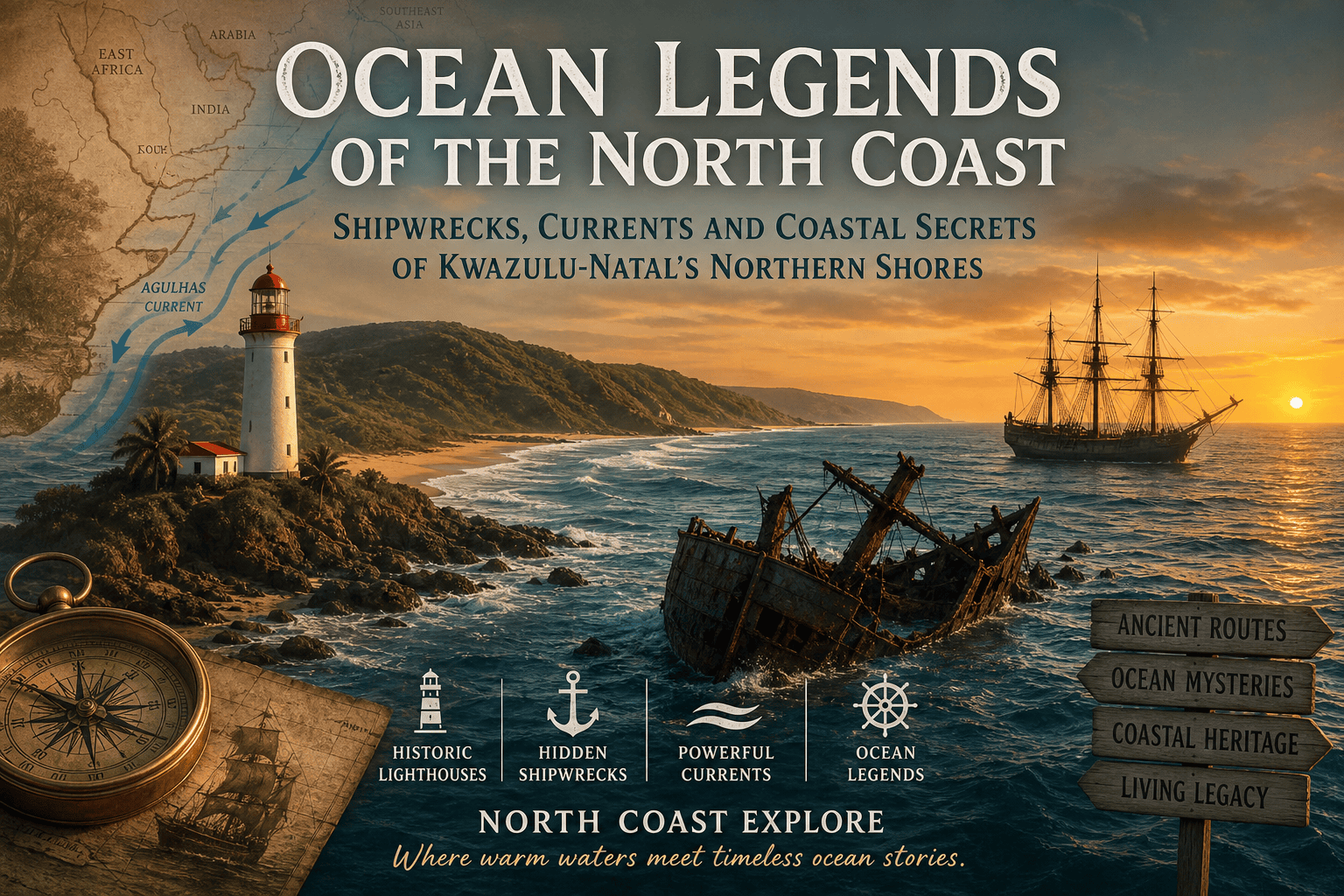
Ocean Legends of the KZN North Coast
Shipwrecks, Currents and Coastal Secrets of KwaZulu-Natal’s Northern Shores
While Cape Town’s Atlantic storms and the South Coast’s ghost ship stories capture the imagination, the KwaZulu-Natal North Coast tells a very different maritime story — one shaped by warm currents, ancient trade routes, and centuries of ocean exploration.
Stretching north from Durban toward the Mozambique border, this coastline has long formed part of one of the most important maritime corridors in the Southern Hemisphere. Beneath its tropical beaches lies a layered history of trade, navigation, survival, and legend.
The Indian Ocean Highway
Long before modern navigation systems, sailors relied on seasonal winds and powerful ocean currents to move across the Indian Ocean.
The warm Agulhas Current flows strongly along the KwaZulu-Natal coastline, acting as a natural “ocean highway” that carries vessels southward at remarkable speed.
For centuries, this route connected:
- East Africa
- Arabia
- India
- Southeast Asia
Trading ships, dhows, and early exploration vessels passed offshore, often staying within reach of the African coastline as they moved between continents.
While the North Coast offered relatively calm seas compared to the Cape, the strength of the current created its own challenges — pushing ships off course and making nearshore navigation unpredictable.
Hidden Shipwreck Stories Beneath Warm Waters
Unlike the dramatic, wind-lashed wreck sites of the Atlantic coast, many shipwrecks along the North Coast remain hidden beneath warm waters and shifting sandbanks.
Storm-driven groundings, navigational errors, and reef collisions claimed numerous vessels over time. Many were quickly buried by sand or absorbed into reef systems, slowly becoming part of the underwater landscape.
Today, divers and coastal communities still speak of:
- Unmapped underwater structures
- Scattered relics on the seabed
- Occasional discoveries revealing forgotten voyages
These fragments form part of a quieter but deeply significant maritime history — one tied to global trade routes rather than storm-driven disaster alone.
Lighthouse Guardians of the Coast
As maritime traffic increased along the eastern seaboard, lighthouses became essential guardians of the coastline.
These beacons guided ships safely past reefs, currents, and shallow sandbanks, reducing the risk of wrecks along the KwaZulu-Natal shore.
For sailors crossing long distances across the Indian Ocean, the sight of a lighthouse meant safety — a critical marker after weeks at sea navigating open waters and shifting winds.
Shipping Lanes of the Southern Oceans
The North Coast sits alongside one of the busiest maritime corridors in the world.
Modern shipping routes running through the Indian Ocean connect global trade between:
- Europe and Asia
- Asia and the Americas
- Regional African coastal ports
Large container vessels pass offshore daily, following established deep-sea lanes that echo ancient trade pathways.
These routes also link South Africa’s wider maritime story:
- The storm-driven Atlantic passages of Cape Town
- The wreck-filled and folklore-rich South Coast
- The warm current trade routes of KwaZulu-Natal
Together, they form a continuous coastal system of movement, trade, and maritime history.
Shipwrecks of Cape Town: Where the Atlantic Tells Its Own Story
While the North Coast is shaped by warm currents and tropical seas, Cape Town’s Atlantic coastline tells a far more violent maritime story.
Here, the meeting of cold currents, fierce storms, and the Cape of Good Hope created one of the most dangerous shipping zones in the world. Over centuries, countless vessels were lost to sudden weather changes, rocky coastlines, and powerful Atlantic swells.
Many of these wrecks now lie scattered along the seabed, forming a dramatic underwater archive of global exploration and maritime risk.
Explore the full Cape Town shipwreck history here:
Ocean Legends and Coastal Folklore
The North Coast is also shaped by oral history and coastal storytelling traditions passed through generations.
Local accounts speak of:
- Unusual lights seen offshore at night
- Brief silhouettes of ships appearing in mist
- Strange ocean conditions linked to strong currents
While many of these stories remain unexplained, they form part of the living cultural fabric of the coastline — where history and legend often overlap.
Connected Coastlines of South Africa
South Africa’s maritime identity cannot be understood through a single coastline.
Instead, it is a connected system of ocean narratives:
- Cape Town: Atlantic storms, wrecks, and global navigation challenges
- South Coast: Ghost ship legends and hidden reef stories
- North Coast: Warm currents, ancient trade routes, and Indian Ocean shipping lanes
Explore South Coast maritime mysteries here:
https://southcoastexplore.co.za/south-coast-ghost-ships-maritime-mysteries/
Together, these regions form a continuous coastal story shaped by exploration, danger, trade, and survival across centuries.
Experiencing the North Coast Today
Modern visitors can still experience the legacy of this maritime history in subtle but powerful ways.
- Long beaches shaped by persistent ocean currents
- Traditional fishing communities rooted in coastal heritage
- Dolphin and whale migration routes following ancient ocean paths
- Coastal viewpoints once used for navigation and observation
Here, the ocean remains an active force — not just scenery, but a living historical system still in motion.
The Ocean’s Living Legacy
Unlike shipwrecks frozen in time, the North Coast’s maritime story continues every day.
Cargo ships still pass offshore, fishermen launch at dawn, and coastal winds continue to shape the shoreline just as they have for centuries.
From Cape Town’s Atlantic wreck zones, to the South Coast’s ghost ship folklore, and into the warm Indian Ocean routes of KwaZulu-Natal — South Africa’s coastline forms one uninterrupted maritime narrative.
Experiencing the North Coast’s Ocean Heritage
Visitors to the North Coast can still feel the influence of maritime history today.
- Long open beaches shaped by powerful ocean currents
- Fishing traditions rooted in generations of coastal living
- Dolphin and whale migration routes following ancient ocean paths
- Coastal viewpoints once used by sailors navigating the shoreline
Here, the ocean is not only scenery — it is history in motion.
North Coast Explore
Where warm waters meet timeless ocean stories.